Scripture Reading — John 12:12–28
"The next day the great crowd that had come to the festival heard that Jesus was coming to Jerusalem. So they took branches of palm trees and went out to meet him, shouting, 'Hosanna! Blessed is the one who comes in the name of the Lord — the King of Israel!' Jesus found a young donkey and sat on it; as it is written: 'Do not be afraid, daughter of Zion. Look, your king is coming, sitting on a donkey's colt!'"
"Now among those who went up to worship at the festival were some Greeks. They came to Philip and said, 'Sir, we wish to see Jesus.' Jesus answered them, 'The hour has come for the Son of Man to be glorified. Very truly, I tell you, unless a grain of wheat falls into the earth and dies, it remains just a single grain; but if it dies, it bears much fruit.'"
"Now my soul is troubled. And what should I say — 'Father, save me from this hour'? No, it is for this reason that I have come to this hour. Father, glorify your name.' Then a voice came from heaven, 'I have glorified it, and I will glorify it again.'"
— John 12:12–14, 20–21, 23–24, 27–28
A Different Kind of Pain
There is a category of pain that does not catch us off guard.
It is not the pain of the accident, the unexpected diagnosis, or the phone call that comes in the middle of the night. That pain arrives uninvited, and it leaves us searching for answers.
No — I am talking about a different kind of pain altogether. I am talking about the pain we saw coming. The pain we signed up for. The pain we chose, with our eyes wide open, because we understood that what was waiting on the other side of it was worth every moment of the suffering.
Think about the athlete. The serious competitor — the one preparing for the championship, the marathon, the Olympic trial. They do not stumble into the pain of training. They set the alarm for 5:00 in the morning and they get up on purpose. They push past the burning in their legs, the ache in their shoulders, the voice that says stop — because they have already decided that the prize is worth the price. The pain is not a detour. The pain is the road.
It is a known and necessary pain.
Think about the preacher who is called to officiate the funeral of someone they love. Not a stranger in the pew — their mother, their father, their child, their closest friend. They stand at that pulpit with their own grief sitting right beside them, and they still have to find the words to comfort the people in front of them. They know before they ever open their Bible that it is going to cost them something. And they do it anyway — because the people need a shepherd, and they are the one God called.
It is a known and necessary pain.
Think about the parent who has to discipline a child. Every parent in this room knows that moment. We look at our child — this person we would lay down our lives for — and we have to do the hard thing. We have to say no. We have to enforce the consequence. We have to let them feel the weight of their choices. And somebody's mother or father told us the truth when they said: this is going to hurt me more than it hurts you. That is not a cliché. That is a confession. The pain of discipline is a chosen pain, born out of a love that refuses to let the child stay where they are.
It is a known and necessary pain.
And then there is the woman who is expecting a child. She has known from the beginning that labor is coming. She has been told. She may have lived it before. She has watched others walk through it. And as the months pass and the day draws closer, she does not pretend it will not hurt. She prepares. She breathes. She holds her partner's hand. And when the moment comes, she endures what she always knew was coming — because on the other side of that pain is a life that did not exist before.
It is a known and necessary pain.
A pain that was chosen, because the purpose required it.
The Crowd on the Road to Jerusalem
We should not be too quick to judge that crowd.
They were not foolish people. They were a suffering people. For generations, Israel had lived under the boot of Roman occupation — taxed beyond measure, humiliated in their own land, stripped of the self-determination that God had promised their ancestors. They had been waiting for a deliverer. They had read the prophecies. They had carried the hope. And now here was a man who had raised Lazarus from the dead — a man who healed the blind, who fed thousands, who spoke with an authority no one had ever heard before. When they heard he was coming to Jerusalem, they did not walk out to meet him. They ran.
Their joy was real. Their hope was legitimate. Their longing was the longing of a people who had been waiting a very long time. We honor that before we say anything else.
Palm branches were not just a warm welcome. They were a symbol of Jewish national victory — the symbol of a conquering hero, of national liberation, of military triumph. When the crowd waved those branches and cried "Hosanna!" — which means, literally, "Save us now!" — they were not simply praising. They were petitioning. Fix the external problem. Give us back what was taken from us. Be the king we need you to be.
They were projecting onto Jesus what they needed him to be, rather than receiving him for who he actually was.
And if we are honest with ourselves — we do the same thing.
We celebrate Jesus as King on Sunday morning. We sing his praises. We lift his name. And by Monday, we have quietly shifted him from King to personal assistant. We bring him our wish list. We tell him what we need fixed and in what order. We celebrate him when the answer comes and grow quiet when it does not. We have taken the King of Kings and reduced him to a genie in a bottle — and we wonder why we feel distant from him, why our faith feels thin, why the joy of Sunday does not make it to Wednesday.
The crowd on the road to Jerusalem missed who Jesus was because they were too focused on what they wanted him to do. Let us not make the same mistake.
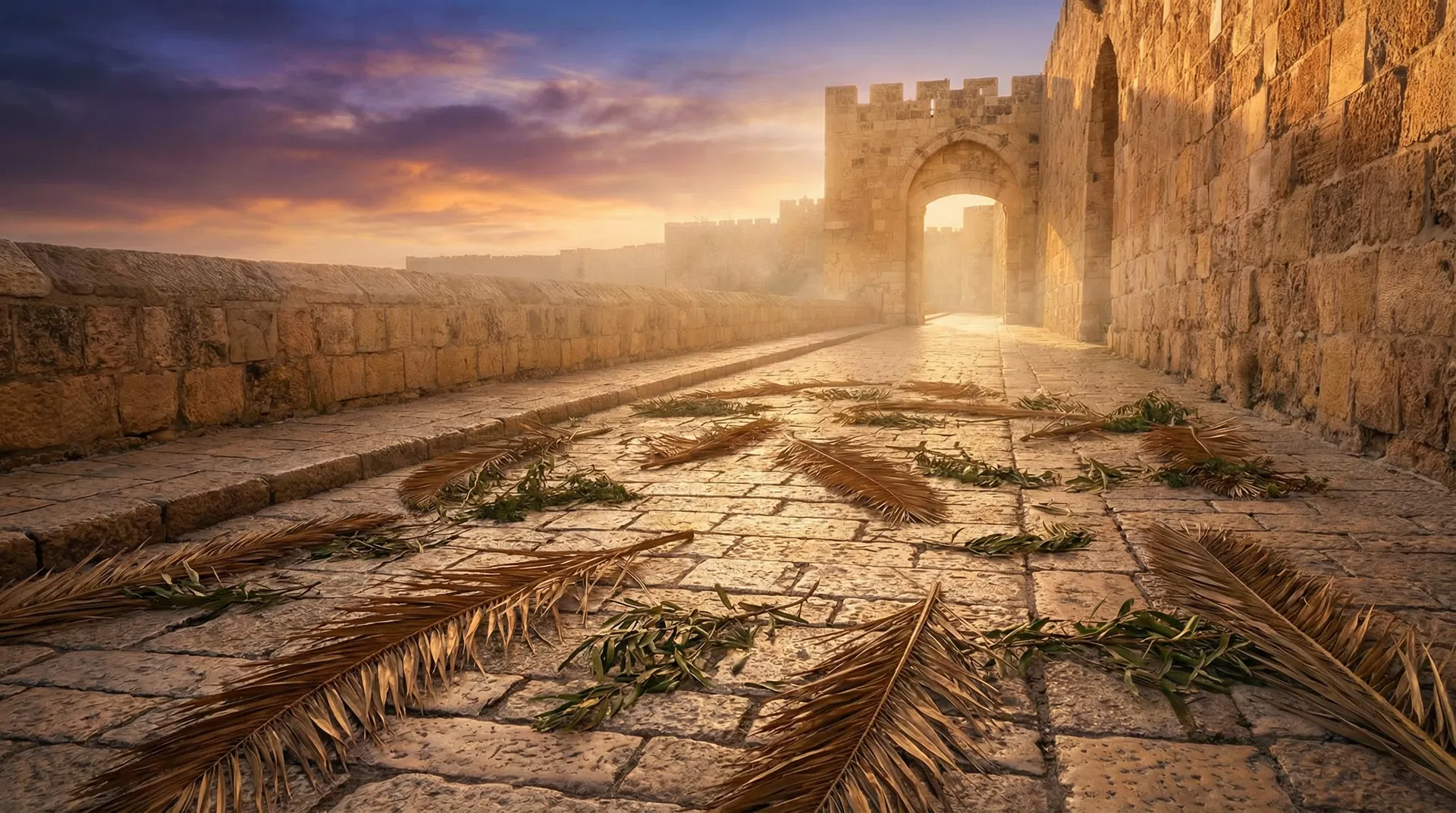
The road to Jerusalem — palm branches laid in the path of the King
What Jesus Already Knew
Here is what the crowd did not see as they waved their palms and shouted their praises: Jesus already knew what was waiting for him on the other side of that celebration.
This was not a surprise. He had told his disciples three times that the Son of Man would be handed over, that he would suffer, that he would be killed, and that he would rise on the third day. He knew the religious leaders were plotting against him. He knew Judas would betray him. He knew Peter would deny him. He knew the cross was coming.
And yet he rode into Jerusalem anyway. He did not take a different road. He did not slip into the city quietly through a back gate. He rode in on a donkey — fulfilling the prophecy of Zechariah — right through the middle of the crowd, right into the heart of the city, right toward the cross that was waiting for him.
The Hill We Cannot Avoid
In verse 27, the scene shifts. The Greeks have come seeking Jesus, and something in that moment triggers a word of profound honesty. Jesus says: "Now my soul is troubled — and what shall I say? 'Father, save me from this hour'? No — it is for this very reason I came to this hour."
Think about the athlete standing at the bottom of the hill.
Every serious competitor knows that moment. The hill is there. It is steep. It is long. The legs are already tired. And the voice in the head says: you could go around. You could take the easier path. No one would know. But the athlete also knows — if you go around the hill, you do not get the conditioning that the hill produces. You do not build what the hill builds. You cannot reach the destination you are training for without going through what the hill requires.
Each one of us will face a pain we could, technically, avoid. We could walk around it. We could delay it. We could find a way around the hard conversation, the difficult season, the costly obedience, the sacrifice that God is asking of us. But if we want to achieve what God has placed before us — if we want to become who God has called us to be — we will need to choose that pain. We will need to climb the hill.
Jesus faced that same fork in the road. "Father, save me from this hour?" He could have said it and meant it. He had the power to call twelve legions of angels. He could have walked away. But he looked at the hill — he felt the full weight of what was coming — and he chose to climb it. Not because the pain was easy. Not because it did not cost him. But because our salvation was on the other side.
He Felt Every Moment of It
We must be careful not to spiritualize the cross into something painless. Jesus did not hover above his suffering. He went through it.
He felt every cursed word they hurled at him. He felt every drop of spit that landed on his face. He felt every lash of the whip across his back — thirty-nine stripes, each one tearing flesh. He felt the thorns pressed into his skull. He felt the nails driven through his hands and his feet. And then — nailed to that cross, with the weight of his own body pulling against those wounds — he had to push up on those nails just to lift himself enough to breathe. Every breath was a choice. Every word he spoke from that cross cost him something we cannot fully measure.
This was not a performance. This was not a man who knew he was God and therefore felt nothing. This was a man who knew exactly what was coming — who had chosen it with full knowledge of the cost — and who went through every moment of it anyway.
He knew it was coming. He knew how much it would hurt. And he chose it. For us.
That is what makes the cross not just a historical event but a personal one. He did not die in the abstract. He died in the specific. He felt what pain feels like — our pain, every kind of pain — and he chose to carry it anyway.
God Is Present in the Pain
And then something remarkable happens.
In verse 28, after Jesus chooses the cross — after he says "it is for this very reason I came to this hour" — he prays: "Father, glorify your name." And a voice comes from heaven: "I have glorified it, and I will glorify it again."
The crowd heard it and thought it was thunder. Some thought an angel had spoken. But God answered.
Here is the word for every one of us who is standing at the bottom of a hill today: when we choose the known and necessary pain that God has placed before us — when we stop running from it and start climbing it — God does not leave us alone on that hill. He speaks. He confirms. He is present in the very suffering we chose for his sake.
The same God who answered Jesus from heaven is present with us in our pain. Not watching from a distance. Not waiting for us to get through it on our own. Present. In it. With us.
He Has Done It
We are on our way to Easter. But before we get there, Jesus has to deal with the known and necessary pain. We do not have Easter Sunday without Good Friday. We do not have the resurrection without the cross. And we do not have the cross without Palm Sunday — without this moment, this choice, this ride into Jerusalem with the full knowledge of what was waiting.
On that cross, God never left Jesus. In the tomb, God never left Jesus.
When Jesus cried out — "Eli, Eli, lama sabachthani" — My God, my God, why have you forsaken me? — he was not crying out of desperation. He was not crying out of abandonment. He was a preacher, hanging on a cross, struggling to breathe, with nails in his hands and his feet — and he was preaching his final sermon. He knew he did not have the energy, the breath, the physical capacity to lift himself up and recite the whole text. But he did not need to. He gave them the first line, and every Jewish ear in that crowd knew exactly where he was taking them.
My God, my God, why have you forsaken me. That is Psalm 22.
And Psalm 22 does not end in abandonment. It ends in glory.
David wrote that psalm out of his own known and necessary pain. Verse 1 — Why have you forsaken me? Verse 16 — Dogs surround me, a pack of villains encircles me. Verse 21 — Rescue me from the mouth of the lions. David is in the valley. He is in the suffering. He is in the pain.
But watch what happens. By verse 22, something shifts: I will declare your name to my people; in the assembly I will praise you. David has not been rescued yet — but he is already praising. The pain has not passed — but the victory is already in view.
And by the time we reach verse 31, David closes the psalm with four words that Jesus wants ringing in our ears while he hangs on the cross:
Not he will do it. Not I hope he does it. Not I am waiting to see if he does it.
He has done it.
The resurrection is not a future event Jesus is waiting on. It is a done thing. It is finished before it happens. While Jesus is in the known and necessary pain of the cross, God has already done it. While he is in the tomb, God has already done it. Easter is not the beginning of the victory — it is the announcement of a victory that was settled before the stone was ever rolled in front of that door.
So the word to us today is this: whatever hill God is calling us to climb — whatever known and necessary pain is standing between us and the purpose God has placed on our lives — we do not carry it alone. And the outcome is not in question. Because the same God who never left Jesus on the cross, who never left him in the tomb, who raised him on the third day — that God has already done it for us too.
"He has done it."
— Psalm 22:31
Will You Climb Your Hill?
Before we leave this place today, there is a question that needs to be answered.
There is a hill in front of us. We know what it is. We have been looking at it. Maybe we have been walking around it. Maybe we have been telling ourselves that the timing is not right, that we are not ready, that it is too hard, that we are not sure God is really asking us to climb it.
But we know. Deep down, we know.
Today, on Palm Sunday, as we follow Jesus into Jerusalem — as we watch him choose the cross with his eyes wide open — we are being asked to make a decision. Not a feeling. A decision.
Will we commit today to go through our known and necessary pain? Will we stop avoiding the hill and start climbing it — trusting that the God who never left Jesus on the cross will not leave us on ours? Trusting that the God who spoke from heaven when Jesus chose the cross will speak into our situation too? Trusting that he has already done it — that the victory is already settled — and that our job is simply to walk through what he has already won?
We do not climb alone. We never have. The God who was present in the garden, present in the furnace, present in the lion's den, present on the cross, present in the tomb — that God is present on our hill.
Benediction
"The Lord bless you and keep you; the Lord make his face shine on you and be gracious to you; the Lord turn his face toward you and give you peace."
— Numbers 6:24–26
Take that blessing with you into this week. Let it make the week feel different — and be different. Because we are not leaving this place the same way we came in. We came in carrying a hill. We are leaving knowing that the God who has already done it is walking up that hill with us.
Go in peace. And climb.